
By Seyla Benhabib
[Editor’s note: Seyla Benhabib is the Eugene Meyer Professor of Political Science and Philosophy Emerita, Yale University; Senior Research Scholar, Columbia Law School; and Senior Scholar at the CCCCT Columbia University. This essay was written for and presented at the Hegel 13/13 Seminar on Marcuse on Hegel]
February 4, 2026
I.
One of the central theses of this year’s 13/13 Seminars on Hegel is that we are living through “Hegelian times.” This is puzzling because Hegel himself believed that he was living through “die neue Zeit;”[1] a new period in human history when the French Revolution, emerging commodity relations and reformed Christianity came together to give rise to the principle of “subjectivity,” namely the emergence of the principle of individual freedom and the recognition of the right of the individual to such freedom – but what kind of freedom- a freedom which extends from free market relations to the free pursuit of a sense of one’s understanding of the good, reaching to free choice of spouse or partner and to the free choice of a profession. In other words, classical liberal freedoms as recognized by the modern state. Are we living in Hegelian times in the sense that a new, alternative, principle of freedom has emerged? Rather, it seems to me that we are living through times when the spirit of freedom is killed. But let us not get ahead of ourselves and try to understand Hegel first.
Having announced the coming of this new age, Hegel, as his critics point out – and Marx above all- compromised the spirit of revolution and the principle of freedom by claiming that the institutions of the reformed Prussian state were adequate to give such freedom an “ethical home.”
“What is rational is actual; and what is actual is rational,” Hegel wrote in the Preface to the Philosophy of Right.[2] (PhR, 10) “Was vernünftig ist, ist wirklich; was wirklich ist, ist vernünftig.” If by what is actual is meant simply what exists, then we can accuse Hegel not only of accommodating himself to the institutions of the Prussian state but of being a poor philosopher who justified the existent; but if what is rational is not yet actual, i.e. does not yet exist, then we can see the reformist kernel of Hegel’s thought, namely to transform reality such that it corresponds to rationality. Or as Marcuse puts it in Reason and Revolution, “The realization of freedom is not a fact but a task.” [3] (RR, p. 26)
Each of these terms requires careful unpacking for they do not mean what we assume them to mean: the actual is not just what exists but it is the conflictual unity of the existent and its essence as grasped by the concept; (exs. A work of art; an act of friendship; a liberal state) nor is reason the capacity for problem-solving, intelligence or accomplishing tasks alone. Hegel has a term for such capacities which he takes from Kant- Verstand. Reason (Vernunft), by contrast, is what grasps reality not only as substance but as subject; in other words, reason is what grasps the objective world, substantiality, as brought about by the conflictual unity of subject and object. Such rationality in the unity of substance and subject can only be expressed as a systematic whole – das Ganze. But here we should heed Marcuse’s warning about the seductions of the Hegelian system which may lead us into accepting the falsehoods that are also part of the whole. Marcuse writes in the 1960 Preface to Reason and Revolutionthat Hegel’s concept of Reason which ia ambitious to grasp the whole could go beyond good and evil and justify slavery, child labor, concentration camps etc.[4] (RR, p. xii.) I don’t think so; I don’t think Marcuse is correct in claiming that for Hegel, “tout comprendre, c’est tout pardoner.” This is a potential danger for second-rate Hegelianism but it is not Hegel. And Marcuse himself adds: “In our time, the rise of Fascism calls for a reinterpretation of Hegel’s philosophy. [Marcuse wrote this book in 1941 when members of the Frankfurt School had left Europe and had temporarily settled in New York with the hospitality of Columbia University]…Hegel’s basic concepts are hostile to the tendencies that have led into Fascist theory and practice.” (RR, xv) Thus, on the one hand Marcuse warns about the quietist tendencies which comprehending the Truth as the Whole implies; while also seeing emancipatory elements in Hegel’s philosophy that are hostile to Fascist theory and practice.
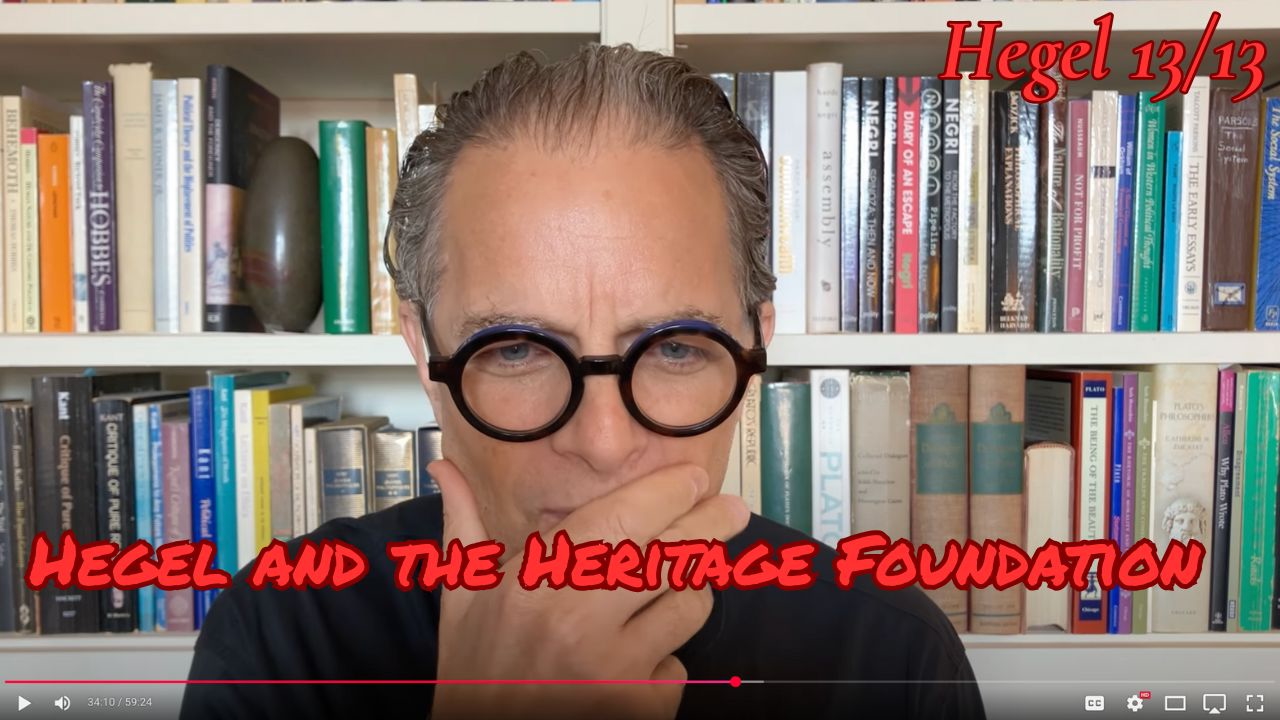
So does the claim that “these are Hegelian times” mean that Hegel is the philosopher of the Heritage Foundation, or should we read and re-read Hegel as an anti-fascist? Marcuse ends Reason and Revolution, by citing Carl Schmitt, whom he calls “the one serious political theorist of National Socialism.” (RR, p. 419) According to Schmitt, on the day of Hitler’s ascent to power, “ ‘Hegel, so to speak, died.’” (ibid) Reading Hegel means encountering the tremendous ambition of the human intellect in seeking to comprehend nature, society and mind itself in the most thorough way; yet it also means being astonished when the power of negativity comes to an arbitrary rest and much social unreason is smuggled into the system. Twice in his career, Herbert Marcuse delved into such Hegelian depths and explored the ambivalence of Hegel’s thought. He saw in Hegel’s philosophy the path forward to a Critical Theory of Society which his colleagues in the Frankfurt School had begun to develop while in exile.
Herbert Marcuse (1898-1979) is, along with Max Horkheimer and Theodor Adorno, among the most illustrious members of the Frankfurt School of Critical Theory. In addition to the 2 works on Hegel which we are discussing in this session, he is also the author of Soviet Marxism. A Critical Analysis (1958); Eros and Civilization (1955); One Dimensional Man (1964). Unlike Adorno and Horkheimer, he refused to return to Germany after the War. Ans although he continued to live in the US, with occasional trips to Germany, he became the one member of the Frankfurt School, even more than Adorno himself, in whom the 1968 student movement trusted and found a voice. With works such as Repressive Tolerance, Counter-Revolution and Revolt, and in particular, An Essay on Liberation, Marcuse gave voice to critiques of consumerism and capitalism and the desire of the younger generation “to drop out and turn off.” His essay on Eros and Civilization, which brought together the Freudian “reality” principle with Marx’s analysis of labor time into a powerful synthesis, contained many themes critical of masculinist sexuality and acknowledged the polymorphous perversity of human desire. These were themes which psychoanalytic feminists, Jessica Benjamin and Nancy Chodorow, would later develop.
II.
What then was motivating Marcuse to read Hegel in 1932 and then again in 1941? Like Marcuse, I am convinced of the emancipatory potential of Hegelian philosophy, and though in my recent work I have made a turn to Kant, I have never left Hegel behind. Like the later Marcuse, I followed the path that led from philosophy to a critical theory of society.
As I explain in the Translator’s Introduction to Hegel’s Ontology and the Theory of Historicity,[5] Marcuse had received his doctorate at the University of Freiburg in 1922 with a thesis on Der Deutsche Künstlerroman, but the publication of Heidegger’s Being and Time in 1927 made him decide to go back to Freiburg. Along with Hannah Arendt, Leo Strauss, Hans-Goerg Gadamer, Karl Löwith, Hans Jonas and others, Marcuse heard the siren’s call of the “magician from Messkirche,” as Heidegger was referred to in those days. After much research, I came to the conclusion that this work was never formally submitted to Heidegger and I found no evidence of the claim that Heidegger had rejected it on political grounds. What is clear is that Marcuse’s hopes for an academic career in Germany, for which this book would serve as a Habilitationsschrif, were dashed with Hitler’s coming to power in 1933.
The lack of explicit reference to Marx and to historical materialism in Hegel’s Ontology, distinguishes this book from Marcuse’s other writings of this period which seek a synthesis between Heideggerian existential phenomenology and Marxist theory. Like Gyorgy Lucas and Karl Korsch, whose work he explicitly praises in essays he published between 1928 and 1933, Marcuse develops an interpretation of Marxist theory that is opposed to the communist orthodoxy as well as to that of the reformist Second International. All these connections are latent in the text of Hegel’s Ontology which moves at a frightening level of abstraction. The ambition of the young Marcuse is to show that the most advanced bourgeois philosophies of this period- meant are Dilthey, Husserl and Heidegger- at many points of their systems reveal the need to go beyond their own framework. Thus Marcuse proceeds from the premise that “The question concerning the meaning of Being of the historical must be posed in relation to the most advanced investigation of historicity.” (HO, xxi)
Heidegger is particularly critical of Hegel’s phrase “Spirit falls into time,” because Spirit is already in time; because Life is through and through temporal. Only beings capable of consciousness can act in such a way as to mediate their past with their present, and transform the given into that which it has been. German etymology makes this conceptual point: in that the pest tense – having been – already contains- being- in it. Sein ist was gewesen ist. Being is what has become and has historicity within it.
Having traveled this tortuous path from Heideggerian fundamental ontology through Hegel’s Logic and to the point when in the Phenomenology of Spirit the social constitution of objective Spirit is disclosed, Marcuse, in his second Hegel book directly moves from Hegelian philosophy to social theory. This is most evident in his reading of Hegel’s concept of “work” in chapter 23 of Hegel’s Ontologywhich recapitulates certain themes of Hegel’s early writings in the Jena period on labor and recognition. (HO, p. 281) These themes have been made central to understanding Hegel’s social theory by Jurgen Habermas and subsequently by Axel Honneth.[6]
III.
Let us return to Carl Schmitt’s phrase with which Marcuse ends: on the day of Hitler’s ascent to power, “ ‘Hegel, so to speak, died.’” That is because Hegel’s 1821 Philosophy of Right is a vindication of the liberal society of the post-1789 period. Yet the state form that Hegel defends is neither liberal nor republican; it is a constitutional monarchy with a representative body, composed of feudal and bourgeois elements. Hegel acknowledged the power of the Prussian landed aristocracy – the Junkers- in this state; he did not permit universal manhood suffrage and instead has corporations – professional bodies- send representatives to the parliamentary assembly of Estates. The representative body also includes a class which had hitherto been quite absent in modern political philosophy: the bureaucracy. This group makes its appearance in Hegel’s Philosophy of Right as the “universal class” (PhR, par. 202) and is hitherto not to be forgotten or neglected. The task of this group of civil servants is to translate the particularistic and competing interests of civil society into the “universal’” i.e. the good of the whole. The constitutional monarch- the sovereign- must only be entrusted to dot the ‘I” and not interfere further with the affairs of the state.
In my view,[7] the greatness of Hegel’s theory of the modern state does not lie in this admixture of bourgeois and feudal elements. But we know why Hegel made this compromise: Having celebrated all his life the Fall of the Bastille on July 14, 1789 with a glass of wine, he nonetheless sought to construct the political theory of the post-revolutionary state in such a way that no particular class or group would be able to act alone in the name of the whole or the universal. The revolutionary instability caused by each competing group in the Assemblée Nationale – French Revolution’s Constituent Assembly, that it alone represented or embodied the will of the people alone, and the continuing conflicts between “constitutive” and “constituting assemblies” in the unfolding of power in the French Revolution,[8] led Hegel to embed the universal instead in a balancing act among competing societal groups. But what about the bureaucracy? Did they not embody the universal and thus act in the name of the whole? Would they not prove equally dangerous? In Hegel’s scheme this class of civil servants would be loyal to the Constitution of alone and would not pretend to have monopoly over its representation. As is well-known, it was Max Weber who took up the puzzles of Hegel’s theory of the bureaucracy in the modern state. Weber developed three ideal types of legitimacy: traditional; charismatic and legal-rational.[9]The modern state bureaucracy represented legal-rational authority in the modern state.
Let us return to Hegel: in Habermas’s famous words, in the PhR Hegel sought to “celebrate the Revolution, but condemn the revolutionaries themselves.” [10] The eros of Hegelian political philosophy is embedded in the reformist and enlightened class of civil servants who tried to modernize the modern Prussian state, but without letting it go off the rails towards either economic or class conflict. These future bureaucrats attended Hegel’s classes en masse; produced some of the best Notes on the Lectures and subsequently went into Prussian state service, and with many German-Jewish students among them.
Neither the reactionary conservativism of the Heritage Foundation nor the revolutionary reaction of National Socialism can embody the spirit of Hegel’s philosophy of the state. For Hegel, the state cannot be the possession of a party, of a movement or of a Fuhrer. Neither can the modern state instill virtue in its citizens as the ancient Greeks and Romans did. The Young Hegel lamented the passing away of the polis but celebrated that the spirit of freedom of modern times would give rise to a more differentiated and complex understanding of civic virtue and belonging. Hegel’s ideal of ethical life is not communitarian because it encompasses conflict, individualism as well as competition within it. [11]Individuals seeking their own ideals of the good come into conflict with others’ conflicting projects who can thwart them as well as misunderstand them. (PhR, par. 129 ff)) Consumers and property owners who compete within the modern “system of needs” (the market place), realize that the modern economy which creates such luxury is nonetheless not wealthy enough to prevent the emergence of the “rabble- of a class of underemployed and unemployed individuals. (PhR, pars.245 and 248) Modern civil society thus engages in the search for overseas markets both to dump its goods as well as its surplus population. Reading Hegels’ account of “the system of needs” is to recognize how much British political economy he had absorbed and how realist he was about the destructive forces of the market. (PhR, par. 189 ff.) This is where I disagree once more with Marcuse: whereas he, like the young Marx, calls attention to the conciliatory elements of Hegel’s theory of the state, I marvel at Hegel’s proto-Marxist account of the contradictions of bourgeois civil society[12]and sense the tragedy in his efforts to situate modern freedom within such a conflictual social structure. Freedom as autonomy is not obeying the universal law; as Axel Honneth notes in his book, Freedom’s Right; it is about finding institutional forms which contain individuals’ search for competing conceptions of the good within a differentiated social whole.[13] A liberal society is a scheme both for competition and cooperation.
Hegel’s thought, and in particular the Philosophy of Right, brings modern philosophy to the point where the classical goals of normative political philosophy, i.e. the search for the good and the just, must now lead to diagnosis of modern liberal society. The tradition of political philosophy had to evolve into social theory. Theorists of the Frankfurt School argued that the liberal society which at one point nourished the autonomous individual had disappeared in the period between the two World Wars. The free market of goods, labor and exchange had given rise to a form of organized monopoly capitalism; the authority of the patriarchal father in the nuclear family would be transformed and give rise to the authoritarian personality who was loyal to the Movement and the Party, and not to the family or the father. [14] Parliament would become the battle ground between class interests. After the devastation of the First World War, the Great depression and the effects of the German war debt, no state bureaucracy could contain or manipulate class conflict. The Weimar Republic was the last Hegelian attempt to base the legitimacy of the modern state on the rule of law and a democratic constitution ,and as Carl Schmitt pointed out this legacy came to an end with Hitler’s ascent to power.
Let me end on a personal note: I completed my PhD thesis on Hegels’ Philosophy of Right at Yale University in 1977. The dissertation was called Natural Right and Hegel. An Essay in Modern Political Philosophy. My goal was to vindicate the legacy of modern political philosophy against Leo Strauss’s charges of nihilism and historicism. I read Hegel as a critic of the social contract tradition but as one who, nevertheless, accepted freedom of the individual as a legitimating ground of the modern state. I tried to show how for Hegel, “abstract right,” those opening arguments of the PhR, were not a justification of possessive individualism in the words of C B McPherson.[15] But they needed to be understood against the background of commodity relations in the modern society, in which property (Eigentum) could only be acquired through contractual exchange- be it through wages or rent or otherwise. I argued that precisely because Hegel knew what contract and property meant in a commodity market economy, he would not base the state on an original act of contract. The modern state came about in history; the task of philosophy was to comprehend its rationality.
Let me end by saying that because all institutions of modernity – property, contract, ethical life, family, system of needs etc. -contain normativity as well as facticity. The Philosophy of Right is Hegel’s account of how such normativity and facticity clash and propel the modern state beyond its own boundaries. The final section of the PhR on World History may be read as spousing Hobbesian realism, in the way that Marcuse does. It leads to Hegel’s most speculative and dialectically uninteresting reflections on world history, and such absurd phrases such as “Die Weltgeschichte ist das Weltgericht,” (PhR par. 341) emerge at this point. “World history is a Court of Judgment” is the subdued English translation!
And this is the point at which I left Hegel’s Philosophy of Right for Kant’s cosmopolitanism.[16]
Notes
[1] G.W.F. Hegel, Phänomenologie des Geistes. [1807] J. Hoffmeister.ed. Philosophische Bibliothek. Hamburg Felix Meiner 1952; engl. Translation, Hegel’s Phenomenology of Spirit, A.V. Miller, trans. with a Foreword by John Findlay. Oxford. Clarendon Press. 1977. All references in the text are to this edition. Abbreviated in the text as PhG.
[2] G.W.F.Hegel, Hegel’s Philosophy of Right [1821], trans. and with Notes by T.M. Knox. New York. Oxford University Press. 1971. Abbreviated in the text as PhR. I have consulted the German edition: G.W.F. Hegel, Grundlinien der Philosophie des Rechts, [1821] in: Eva Moldenhauer and Karl Markus Michael, eds. In Werke in zwanzig Bänden. Frankfurt. Suhrkamp. 1970, vol.7.
[3] Herbert Marcuse, Reason and Revolution. Hegel and the Rise of Social Theory. [1941] Boston, Mass. Beacon Press, 1968. All references in the text are to this edition and abbreviated as RR.
[4] Hegel’s views on slavery were first succinctly summarized in the chapter on ‘Lordship and Bondage’ in the Phenomenology. Susan Buck-Morss provides an illuminating account of how the Haitian Revolution may have been a source of inspiration for Hegel in: Hegel, Haiti, and Universal History. Pittsburgh: University of Pittsburgh Press, 2009.
[5] Herbert Marcuse, Hegels Ontologie und die Theorie der Geschichtlichkeit [1932]; revised 1968. Frankfurt: Vittorio Klostermann; Engl. Translation based on the 1968 ed. Seyla Benhabib, Hegel’s Ontology and the Theory of Historicity. Boston. Mass. MIT press, 1987. Referred to in the text as HO.
[6] Jürgen Habermas, “Labor and Interaction. Remarks on Hegel’s Jena Philosophy of Mind,” Theory and Practice, trans, by John Viertel. Boston: Beacon Press. 1974, pp. 124-170; Axel Honneth, “Work and Instrumental Action,” New German Critique (Spring-Summer 1982), pp. 31-54; See Axel Honneth, The Struggle for Recognition. The Moral Grammar of Social Conflict, trans J. Anderson. Cambridge, UK. Polit Press. 1995.
[7] For a more detailed discussion of Hegel’s theory of the modern state, see my early book: Seyla Benhabib, Critique, Norm, and Utopia. A Study of the Foundations of Critical Theory. New Yok, Columbia University Press, 1986.
[8] Hegel first discusses the historical developments of the French Revolution in the PhG, in the section titled “Absolute Freedom and Spirit”: in Chapter 5C.
[9] Max Weber, The Theory of Social and Economic Organization, trans. A.M. Henderson and T. Parsons. New York. The Free Press, 1947.
[10] Jürgen Habermas, “Hegel and the French Revolution,” in: Theory and Practice, trans. by John Viertel. Boston: Beacon Press. 1974, pp. 121-141.
[11] See Benhabib, Critique, Norm and Utopia, ch. 3, pp. 70-102 where I discuss this at greater length.
[12] See Seyla Benhabib, “Obligation, Contract and Exchange: The Opening Arguments of Hegel’s Philosophy of Right,” in: Hegel’s Political Philosophy, ed. Z.A. Pelczynski, Cambridge: Cambridge University Press, 1984, 159-77
[13] See Axel Honneth, Freedom’s Right. The Social Foundations of Democratic Life, trans. by J. Ganal . New York. Columbia Universiyt Press, 2014. See my contribution to Axel Honneth’s Festschrift which discusses our common beginnings in Hegel’s social and political philosophy, S. Benhabib, “Hegel’s Concept of the Person and International Human Rights,” in S. Benhabib, At the Margins of the Modern State. Critical Theory and Law. Cambridge, UK, Polity Press, 2025, pp. 32-46.
[14] In Critique, Norm and Utopia, I trace this evolution from Hegelian theory of the state and bourgeois society to the diagnosis of the Frankfurt School, pp. 147-182.
[15] See S. Benhabib, “Obligation, Contract and Exchange: The Opening Arguments of Hegel’s Philosophy of Right,” in: Hegel’s Political Philosophy, ed. Z.A. Pelczynski, Cambridge: Cambridge University Press, 1984, 159-77, and “Hegel’s Concept of the Person and International Human Rights,” in S. Benhabib, At the Margins of the Modern State. Critical Theory and Law. Cambridge, UK, Polity Press, 2025, pp. 32-46.
[16] My serious consideration of Kantian ethics began with Habermasian discourse theory but I carried Hegel’s critique of Kant into my reflections on discourse ethics as well. See Seyla Benhabib, Situating the Self: Gender, Community and Post-modernism in Contemporary Ethics, Polity Press and Routledge, Kegan, Paul; London and New York, 1992, pp. 23-68. Kant became a crucial reference point for me with his work on the right of hospitality and cosmopolitanism, see. S. Benhabib, The Rights of Others. Aliens, Citizens and Residents, Cambridge University Press, 2004.